I have been critical lately of the US government for being slow to act and not forward looking to potential threats, especially those that affect national security. But lately, they’ve been on the ball. The Dems have passed a bevy of new legislation, and if you don’t believe me, just ask Chuck Schumer-if you have an hour. But the new big deal shows some vision towards protecting the future of technology. Joe B just signed a $52 billion bill in support of American semiconductor production. What makes this, to use a favorite of Big Joe’s, ‘a BFD’, is that the U.S. is woefully underdeveloped in the production of this micro gizmo that makes all things electronic run. From cars to toasters to rockets, no semiconductors, no go. Especially our military equipment and satellites. And most important of all, our cellphones! The global master of the game is Taiwan, aka ‘Free China’. For now.
The 69-year-old President Xi of China, or as Trump once famously called him “X-I”, is a dynastic dinosaur trying to define his legacy by redrawing China’s borders. China lost the island in a war with Japan in 1895, signing a treaty that ceded Formosa (precursor to Taiwan) ‘in perpetuity’. After WWII, when Japan surrendered unconditionally, Taiwan reverted to Chinese control in the Treaty of San Francisco, circa 1945. Then came the civil war, with Chiang-Kai-shek attacking northern provinces in China, eventually losing at the close of 1949, fleeing to Taiwan and importing his Republic of China (ROC) brand, serving as its president for 25 years until his death in 1975. Don’t let the Republic in the title fool you; one of his first acts after taking control in Taiwan was instituting martial law.
Since then, the country has moved towards democracy and enjoys a robust technology-based economy. Still in opposition to the Peoples Republic of China (PRC), the communists on the mainland, Taiwan President Tsai Ing-wen, says the country’s future belongs to the people of Taiwan, not others. Aiding her in standing up to the Peoples Republic of China is the Taiwan Relations Act (TRA), signed with the U.S. in 1979, agreeing to maintain all relations with Taiwan sans diplomatic ones. More importantly, it agrees to arm the small island nation just 70 miles from the Chinese mainland with weapons to ‘maintain a self-sufficient defense’. What does that mean, exactly? Intentionally vague, for sure.
Since the late ‘70’s, a great deal of ambiguity exists on Taiwan’s status as an entity. The U.S. and U.N. granted diplomatic status to China, while recognizing Taiwan’s right not to be bullied. Regarding reunification, the TRA states that while Taiwan belongs to China, it’s return must be peaceful, hence the weapons clause. Some would call that statecraft, but not many.
What makes this international conflict increasing intense is a single product: semiconductors.
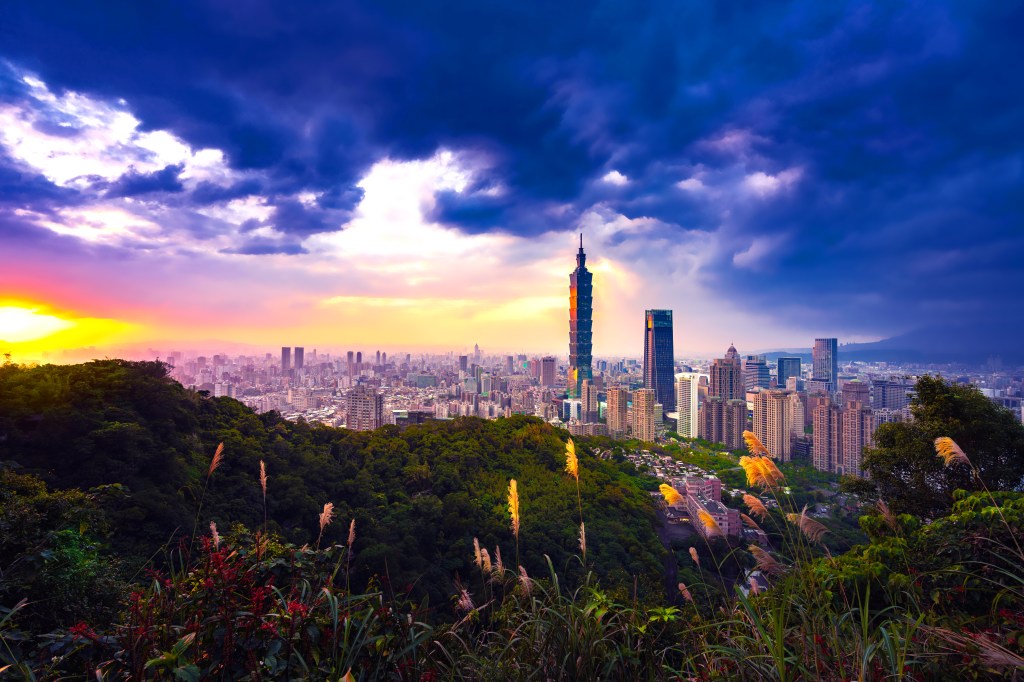
Taiwan produces more than half of the global supply of them at their ‘fabs’ where the semiconductor chips are fabricated. Hsinchu Science Park just south of Taipei is their equivalent to our Silicon Valley. Spread over six locations and housing over 400 tech companies, it’s massive. By far the big dog is Semiconductor Manufacturing Company Limited, or TSMC. They make about ninety percent of the most powerful microchips- called nodes below 10 nanometers- that’s technical talk that loosely translates to super tiny package with whopping mad computing power.
Since Nancy Pelosi’s visit last week revealed, China flips out over any foreign visitors to Taiwan for any reason. Especially democratically elected ones. In anticipation of the potential backlash of her visit, the U.S. Department of Defense rescheduled an unarmed nuclear missile test from the Vandenberg Space Force base in California toward the Marshall Islands some 4000 miles away. While China momentarily wigs out over unapproved visits to Taipei and the U.S. shrugs it’s shoulders, backstage it’s a different story.
China has long said that Taiwan belongs to them. I don’t think they cared too much about Taiwan when it was just a fishing village, they were just sort of calling dibs on the island. The game changer was two-fold. First, as a younger generation is coming into its’ own in Taiwan, and this well-educated class thumb their collective noses at China’s politics and culture, far more than their parents. And while that may miff the Chinese, what’s really piqued their interest is the semiconductor industry blossoming there. A peculiarity to this business is that the power of their product doubles in computing power every two years. This alone makes it very hard for anyone behind them to catch up. Even the Chinese, and it’s estimated they are at least a decade behind. Nearly the sole producer of those mad speed chips previously mentioned, as a country they are earning monopolistic level cash. Even with Big China making everything Jeff Bezos can sell, they must be just green with envy.
As much as China needs (and covets) Taiwan’s boss microchips, the concern is that they may just roll on in and take it. Or take some boats, you get the gist of it. Even Taiwan’s 300,000 strong military would be no match for them. One U.S. estimate has them lasting maybe two weeks. However, the complexity and interconnectedness of the global marketplace serves to protect them. The Taiwanese quietly refer to this as the “Silicon shield”. To invade them would destroy their product, by virtue of the raw materials, designs and other products that are outsourced being sanctioned. Think of the sanctions placed on Russia after their Ukrainian invasion. They can’t even get a quality cheeseburger in Moscow now. Thus, any pretense to claw back the small island just 70 miles across the Taiwan Strait would be counterproductive at best.
Besides, they have better things to do. Their long-term Belt and Road Initiative (BRI) has at least 139 countries signing the Memorandum of Understanding. China’s aim is to globalize their brand through trade, infrastructure and finance. Started by President Xi in 2013, its name harks back to the glory days of the silk road from a century BCE to the fifteenth century. Named after China’s silk textiles, the routes ran 4000 miles from coastal China to the western Mediterranean to the Horn of Africa. It’s a grand concept and certainly more than the five year plans they’ve been fond of. Ambitious? Certainly, but I wouldn’t bet against X-I. Besides, what else are they going to do with all of that Amazon money?
 Theo 20/20